



We examine sensitive placements of planets near chart angles that make planets more powerful and significant within a birth chart.
Sometimes planets operate in more than one house! Learn how to identify such planets and how to blend meanings for multiple houses for a single planet.
Retrogrades often get a bad reputation on the internet for seemingly being 'slow' or being 'incapable' of expression. But in actual fact, some of the world's best often have Retrograde placements. Find out how these planetary conditions can be used very positively.
What happens when planets cluster heavily on one side in the birth chart, and what happens if it is all scattered? Does it have any significance? Here we do a detailed analysis of the various Chart patterns in astrology and what it means.
Those coloured lines that connect planets in a birth chart – Aspects are among the most difficult astrology techniques to self-learn. Here we break down the types (and sub-types) of the aspects, with interpretation strategies.
Taking Aspects to the next level of interpretation when different planetary Aspects form relationship linkages know as an Aspect Patterns. How do you then blend the complex interpretation combinations together?
The Lunar Nodes describe a unique life purpose journey, should you choose to accept your mission. Learn how to extract this story and uncover the price of the journey to the North Node.
Explore your own inadequacies but also how the ‘Wounded Healer’ unlocks your healing abilities and your ability to help others.
Bounds as the name suggests, it means to operate within the confines of rules and regulations. But what happens when a planet is considered Out-of-Bounds? Does this mean that the person is constantly a chaotic character? Learn to interpret this planetary conditions and show positive ways of using it
Singleton refers to the concept of it being either the sole planet of a particular Mode or Element. Often, it operates in isolation but it is also important to recognise it's presence. Get to learning to interpret such emphasis in the charts.
We examine the concept of Antiscia and how it forms psychological triggers and influences the psyche. See the mirror reflection that awakens purpose within self.
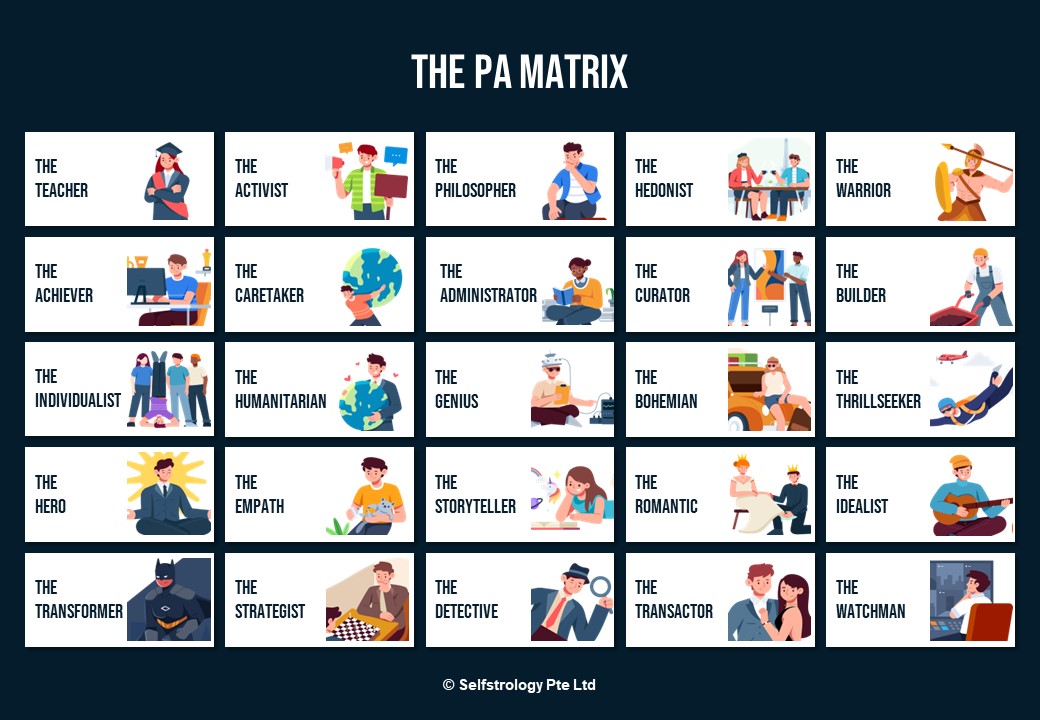
The 25 different Psychological Astrology Profiles™ is a framework developed by May Sim, from years of experience consulting clients as well as teaching classes. Each profile comes with a very specific backstory and manifestion behaviour that often explain why we all have particular way of doing things and the way we think.
Each of the Psychological Astrology Profiles™ have multiple ways of being triggered. Most people trigger between 9-19 of these profiles. In the course, you learn the ways how each profile is being identified.
Each of the Psychological Astrology Profiles™ also play out differently in people lives. Some may experience certain profiles stronger than another. Learn how to apply the weightage and strenght of the profiles within a chart.
This course is suitable for students with no prior knowledge of astrology. The structured curriculum allows you to build from the basics (such as the different symbols, planets, zodiac signs, houses etc.). The learning management system that includes online resources such as easy-to-watch videos that you can watch at your own pace and simple course assignments that you can apply to your own astrological chart.
If you do not have access to an accurate birth time, please email us at hello@selfstrology.com upon your enrolment so our administrators can arrange for one of our astrologers to carry out a chart rectification (calculating backwards from your life events to find your accurate birth time) for you. Please note that this will incur an additional rectification fee of $250-$450, depending on how uncertain your birth time is (if you can narrow it down to within an hour/60 possible birth times or if the astrologer has to work with a full 24 hour/14440 possible birth times).
The intermediate courses require a solid foundation in astrology and most self-taught hobbyists are not expected to be able to keep up with the content – the course is taught on the expectation that you have already completed the basic syllabus.